Are Our Children Really Overprotected? I Think They Are.
 Mamacita says: Are we protecting our children too much? Everything is so bland, so effortless, so sanitary, so entitled, so sterilized, so soft, so completely without risk, requiring little or no talent or skill, so full of self-esteem and so lacking in merit, that it is little wonder so many of our young adults wouldn’t survive three days on a desert island without a camera crew on hand to keep them alive when push comes to shove. There’s no WiFi on a desert island. Many people would die in less than a week without their WiFi. (They don’t know how to grow or hunt their own food or make a fire or a shelter, etc. They’re pathetic.)
We’ve got children who not only wouldn’t know how to climb a tree to save themselves from a bear attack, they probably wouldn’t know any better than to assume the bear was a sweet thing that welcomed a Kodak moment. We’ve got children who’ve never walked around their own block without at least one adult present. We’ve got children who have never in their entire lives played in their own back yard without adult supervision.
Our kids have never organized their own games, made their own friends, walked to the neighborhood store, jumped rope, been outside after dark, put lightning bugs in a jar, or gotten dirty without a scolding.
Today’s kids get passing grades without really passing, sports trophies without really playing, and attendance awards even when they’ve missed six days for orthodontia appointments. Bullies receive more sympathy and help than their victims. Disruptive students are allowed to remain in our classrooms, destroying the learning opportunity for other kids. (Disability or not, no child should be included IF that student presents a danger to other children, or in any way prevents other children from learning. I’m not backing down on this one.)
These kids have no organizational skills because all their school supplies are in big bins that everyone helps himself/herself to – many of these students will go to college and expect their professors to provide the pencils and paper. How do I know this? I am a college professor, and every semester, at least one younger student wonders where the paper, pencils, paper clips, and staplers are kept. When they are told to supply their own, these students are absolutely flabbergasted.
Many kids these days would not know what “flabbergasted” means.
Their playgrounds look like the toddler room in the church basement, not a single pair of jeans has had to be patched, they’re chastized if they get dirty, and they have never had a broken bone or stitches from just being a kid and playing in their lives. Simple falls, slips, bumps, and bruises are Benadryl foddder. They’re not allowed to climb because they might fall. They can’t whirl and twirl because they might fall. They can’t run because they might fall – or make some child who can’t run as fast feel bad. They can’t throw or kick baseballs or footballs or kickballs because someone might get hit, or get upset at witnessing another child’s skill. Imaginative play is forbidden lest it include a pirate sword or a finger gun or some kind of sexist, non-PC labeling.
What’s next? No walking, because they might fall? It wouldn’t surprise me.
Many kids are not allowed to make their own friends because unless the parents can also be friends, it just ain’t happening.
Children are allowed to run wild in public places, eat and drink anywhere they want, talk during movies, and pretty much rule the roost in their own homes and anyone else’s, too.
Excuses, reasons, and rationalizations are made for all misbehavior. It is never the child’s fault. He can’t help it.
Many children eat what they want whenever they want it. Parents are so afraid little Lulu and little Tubby will be hungry or their self-esteem will be eroded that they cater to these little monsters in every way. If anyone objects or finds fault, that person must be a child-hating ogre who just doesn’t underSTAND how sensitive Lulu and Tubby are.
Teachers are too strict and require too much. Theater patrons who glare have forgotten how it was to be a free-spirited child. Restaurant servers and customers are just hateful selfish beasts who ought to appreciate children and not expect them to be sentient. Fast-food restaurants FORCE families to eat there every night, and that we are all fat isn’t our fault -it’s the restaurant’s fault for MAKING us go there.
Am I in a bad mood? Not at all. I am actually more amused, in a head-shaking, disgusted, sarcastic, snarky way, at so many young parents these days who are making it so difficult all the time when it really shouldn’t be.
When people allow children to be in charge, life is going to be hell. Plus, these parents are also responsible for encouraging their children to grow into adults who must be ever entertained from without, who can’t sit still for thirty seconds, who have poor eating habits, shoddy entertainment preferences, and a sense of entitlement and blamelessness that should shame the nation.
P.S. Parents who allow their children to be in charge DESERVE the hell they are nurturing. Is that harsh? Bite me. The truth hurts.
Yes, I am aware that such things have been said about the younger generation for thousands of years. That doesn’t make it any less true.
I love children too much to stay quiet. We need to nurture them, love them, cherish them, and require them to genuinely grow up, and that means, to have the knowledge and skills to take care of themselves and of others.
Nobody has the right to be helpless unless he/she really is.
Good Teaching Is Like Good Stand-Up.
 Mamacita says: I love children, and I love students of all ages, and I love teaching, and I love genuine education in all of its 6-degrees-of-separation wonder. Everything is connected – everything in the known and unknown universe is connected. Nothing exists only within the four walls of a classroom. It often happens – I sincerely hope – that in the course of our education we are required to learn something we simply do not understand.
“Whyyyyyyyy do I have to learn this? (Best said in a whiny, nasal tone.)
There are many answers to this question, all correct, although “Because it’s going to be on the test” is the poorest answer, even though it might be the only answer the student is capable of understanding AT THE MOMENT. Education is so full of wonders that it’s difficult to highlight just one, but I’ll give it a shot.
One of my favorite educational wonders is the simple fact that there are many things we learn for which we know no immediate reason. This not “knowledge for knowledge’s sake,” although I love to know things just to know them. This is “life prep.”
Hasn’t it ever happened to you, that five, ten, thirty, sixty years later, something pops in your brain and suddenly you make a connection to that little poem your mean third grade teacher made you memorize much against your will, and you are able to comprehend something?
I thought so.
THAT’S why you “have to learn this stuff” now. Some of it is for today, and some of it is for tomorrow, and some of it is for when you’re seventy-two years old and struggling with questions far more difficult than school ever made you do. Each of your teachers is trying to prepare you not merely for the next grade up, but for all of the rest of your life. Everything you have ever learned is stored away in your head, somewhere, waiting to serve you “later.” Good teachers know this, and do their level best to encourage students to find and understand the connections and relationships between and among “things.”
That’s what I’ve always tried to do, anyway. I didn’t learn that in college. I learned it from some of my own teachers. Not all; just the good ones. I learned plenty from the bad teachers, too, and not just because bad examples are as useful – and sometimes more so – than good examples. The many good teachers in my life taught me much more than their job description required, and it was these “tangents” that taught me the most. I do this with my students, too, and often those tangents end up being more important than the actual lesson.
If our children learn nothing else in school, I hope they learn about the connections, which are, of course, also relationships. Connecting the dots between math and English and science and history, etc, will help us all want to learn more, and more, and more, and never stop learning more. I consider that to be my primary goal. Perhaps knowing these things about me will soften what I am about to say next, which is simply this:
It’s no surprise to me that a student doesn’t much like to sit still and pay attention when the instructor is boring, lackluster, monotonous, incompetent, and uninformed. (Or any one of those things.) Excellent lessons require much more than books, paper, and pencils; they require the skills of a savvy standup. You can’t teach Period 7 the same way you taught Period 2; it’s a different audience.
However, I still maintain that the majority of responsibility for learning lies with the student, not the teacher. A person who desires to learn will learn in spite of all of the obstacles our modern educational system puts in his/her path, and believe me, modern educational systems put all the obstacles in the path of our students that they possibly can.
It’s still – mostly – the student’s responsiblity.
Bring it on.
(Another re-run. We’re moving this week. I’m buried alive in stress, mess, & junk. This house is a hoarder’s dream.)
Teachers and The Knack
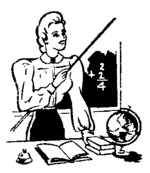
Mamacita says: There is a knack to teaching middle and high school students that some teachers never quite learn. I’m not sure it can be learned; it might be an art, a talent one must have at birth. For want of knowledge of this art’s actual name, I will call it ‘the knack.’
I have seen many teachers fail at the secondary level, because they just simply did not have ‘the knack.’. I have seen a lot of excellent, successful elementary teachers fail at this level, because they did not have ‘the knack.’
It’s easier to do at the upper high school level, because some of those students are more mature than some adults I’ve known. But at the middle school level, and the lower high school levels, it’s harder to do, and even more important to do it.
Once in middle school, students are no longer ‘children.’ Oh, we know they still are, but don’t make the mistake of treating them as you would treat a fifth-grader.
Never talk to older students as you would talk to younger ones.
A teacher can lose an entire group of seventh-graders simply by referring to them as ‘boys and girls.’ I’ve seen entire classes turn against a teacher because he/she used a tone of voice that connoted ‘elementary.’ I’ve seen principals wonder all year why the students disliked him/her so much, and it was all because of a condescending remark made on the first day of school, that the adult doesn’t even remember but every student knows by heart.
Never talk down to older students. Or younger ones either, for that matter.
Put simply, talk to older students as THEY THINK you talk to other adults. And put simply, that’s not simple.
It is possible to talk to an older student about very serious matters, or matters that are actually frivolous but which are important to the student, in a tone of voice that tells the pre-teen or teen that you consider them capable of reasonable judgment, and that you respect what they have to say. Two teachers can say the exact same thing and one of them will succeed while the other antagonizes and infuriates the student.
There is some kind of internal attitude inside each teacher, and the least astute kid in the entire school can pick up on it.
Being a good teacher is hard work, exhausting and nerve-wracking. Loving kids isn’t enough to be a good teacher. Being organized isn’t enough. Being passionate about one’s subject isn’t enough. Being a member of Mensa isn’t enough. Having been an excellent student oneself, isn’t enough. Ditto on having been a poor student. Having kids of your own isn’t enough. Wanting desperately to have kids of your own isn’t enough. Having had an excellent teacher in one’s past isn’t enough. Having had a terrible teacher in one’s past isn’t enough. Being the favorite Aunt or Uncle to tons of nieces and nephews isn’t enough. Combinations of these things aren’t enough.
Oh, those are excellent parts of a teacher’s background, yes. Definitely. But alone or in any combination, they are not enough.
To be able to deal with secondary students, to be able to communicate and earn their respect, a secondary teacher has to have the right kind of internal attitude.
Can’t some of you still instinctively know when someone is sincere? Do you still have that radar detector in your brain that tells you when somebody can be trusted? Pre-teens have this instinct, and it’s sharp and clear and laced with brand-new hormones, a big hunk of ‘fear of the unknown,’ and an intense desire to be accepted.
A good teacher must understand the pack instinct of teens, and be good at intervening, listening, and helping them to realize that it’s not the best way to live. Some cliques at this level can be brutal; a good teacher watches for such things like a hawk and simply does not permit it
in his/her classroom. A good teacher must have shock absorbers in his/her heart, because some of the things older kids will tell them are real zingers. A good teacher knows how to speak the “language: of all the different social groups within the system. (A REALLY dedicated teacher is bilingual.) A good teacher knows how to encourage individuality and creativity, and be able to stand firm when a student or his parents try to buck the system and gain privileges which that student did not personally earn. Other students know when this happens. Word gets out, and it gets out fast.
Good teachers are probably just a tad on the schizo side, because every time the bell rings, they have to shake off one personality and put on another. No two classes are alike, and a good teacher will not try to teach them in the same way. Secondary teachers are doing stand-up, and audiences differ with every gig.
It goes without saying that a good teacher will not compare a student with his/her older brother or sister, even favorably. Each student stands, or falls, on his/her own merit and work habits. Students respect that, even when they try to sway the teacher. They know that some teachers are easily swayed, more’s the pity. (The good teachers aren’t.)
Secondary teachers, the good ones, know how to talk to the students as the students  think one adult talks to another. Read that sentence carefully, for it does not say that a good teacher talks to the students as one adult to another.
Some teachers will not agree with me. That’s fine. All I know is, those things worked for me, and for several other teachers that I know.
I’ll add this, too: A good secondary teachers keeps up. He/she knows what the students are reading, and what they’re watching, and what they’re listening to, and who. This is absolutely vital at this level. If you are conversing with a secondary student and that student happens to drop the name of a band and tells you this band is his/her idol and he/she adores them, and you don’t know ahead of time that this band advocates drugs and violence and kinky sex, and that the lead singer has been arrested for DUI and CDM several times, something ignorant such as “Oh, me too, aren’t they awesome?” might be said. And any teacher who doesn’t know ALL about Facebook and texting and pretty much all other aspects of social networking has no business at either the elementary OR secondary level. Check that stuff OUT, because I’ll tell you what, your students sure are. Get on there yourself so you can communicate.
These things have to be done carefully, remember. Don’t make the mistake of trying to ingratiate yourself with students by using their generation’s groovy, out-of-sight, beat-me-daddy-eight-to-the-bar, gnarly vernacular with them. Some words were never meant to come out of the mouths of actual adults. Am I right, peeps?
All of these things, and more, can be done if a teacher has that internal attitude, the right attitude, the one that can’t be detected by anyone except a teenager. Sometimes, other teachers sense something different about a really good teacher, and there are occasional clashes. Age has nothing to do with it; some of the very best teachers are 110 years old if they’re a day, and some of the least savvy ones are 25.
Middle school kids are the greatest; I loved teaching that age level. Teachers who tell you that those grades are a nightmare just didn’t do it right. Such statements are unkind, and untrue.
I am not, of course, referring to NASTY SPOILED BRATS WHO HAVE NEVER BEEN REQUIRED TO BEHAVE PROPERLY IN PUBLIC, but that is their parents’ responsibility and fault. They should arrive at school already knowing how to behave. But I’ve ranted about that too much already. . . . .
Good parents always go to parent-teacher conferences, of course. While you are there, see if you can dredge up some of that adolescent attitude detection you used to have. Check out your kids’ teachers.
I’m not saying to sniff them all over like a dog, but wouldn’t it be cool if we could? Heh.
At any age, we could all use (to paraphrase Hemingway) a good, built-in shock-proof shit detector. Our students need it for us, and we need it for them.