Where Did the Music Go?
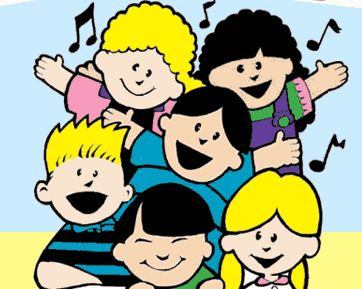 Mamacita says: Back in the day (when dinosaurs roamed the earth) every American student knew hundreds of songs – all the same songs, for the most part. Every Wednesday morning, kids all over the States would gather in their school’s auditorium, or cafeteria, and sing. In my little grade school, it was called the All-School Sing. The music teacher was in charge, and she didn’t ‘teach’ the students much of anything. She just started playing and all the older kids joined in, and after a few weeks the younger kids had picked up all the lyrics and joined in, too. It was an awesome way to learn the songs, imitating the cool big kids!
Every kid in my generation and before knew all the words to all the verses of most ‘standard American songs.’ We had songs for every holiday, every season, every celebration known to mankind, yes, even the minority ones. We knew dozens of patriotic songs. Funny songs. Indiana songs.
Even more importantly, we knew the major themes from hundreds of classical selections, because they were taught to us beginning in kindergarten, with age-appropriate lyrics. To this day, my generation can hum great classical music.
I think my generation, and the half-generation after me, were the last to benefit from this fantastic program. Shortly afterwards, it was deemed a waste of valuable class time, and it was done away with.
In my grandparents’ generation, music was so important in the schools that if the orchestra lacked a particular instrument or chair, a professional was hired to fill it. If you read “A Girl of the Limberlost,” you will see examples of such things. (you really should read that book, but before you do, you have to read “Freckles.” It comes first. Both are by Gene Stratton Porter, and are absolutely wonderful. WONDERFUL.)
I still have my music textbooks from grade school. They are full of sweet little songs, most of which use the melodies of famous classical compositions. As children we didn’t know that, of course, but as we got older and found out what we actually KNEW, we were astounded and felt so cool. The love of those melodies had been instilled in us, and it would never leave us. And it made us seek out the actual compositions themselves, that we might hear it all.
And in the back of each of those books is the synopsis of an entire opera.
What do kids learn in music class nowadays? People like my sister do a fantastic job, considering the limitations put upon them, and the ridiculous even-larger-than-regular-classes student population thrust upon them all at once, but many schools have done away with music altogether, because they need the time for ISTEP review. In most schools, the students wouldn’t recognize a treble clef if it hit them on the head. And Beethoven is a big dog.
I used to quiz my middle school students about songs. Few knew many that weren’t on the radio or TV. Why don’t kids these days know anything about real music? Because they aren’t taught anything about it. And since the schools dropped the ball, others picked it up and ran with it, and our seven-year-olds are wearing thongs and crop tops and running around the playground singing about sex. It’s sadder than we can even comprehend.
Oh, I don’t knock their music. I like a lot of it. It’s just sad that they have nothing in addition to it. They have no firm musical foundation, so they really can’t say “this is good because. . . . ” or “this is terrible because. . . . .”
And when they hear a song, they don’t associate it with a person, or a place, or an occurrence, or where they were or what they were doing. They associate it with a video. Their musical memories revolve around seeing a celebrity lip-synch.
No wonder so many things just plain ‘suck.’ They suck, because they’re bad and there’s no background or knowledge about why they suck.
Personally, I believe that messing with music programs in schools sucks, and I CAN tell you why. And I just did.
My mind’s eye can still see the Parkview School’s cafeteria full of little kids, sitting on the floor, grouped by grade and classroom, singing away. I’m sure there were discipline problems, but I don’t remember any. The kids were too busy modeling the big kids and singing. Miss Keach, the traveling music teacher, sat at the piano, on the stage, playing and singing along with us. She was wonderful. She visited each classroom about once a week, teaching us the basics, and she expected us to use them while we sang our cares away at the All School Sing on Wednesday morning. And we did.
I still can. Every word of every song. It’s won me many a Jeopardy round with my family, and brought me amazing comfort and given me innumerable connections with other seemingly unrelated things, until we remember that nothing is unrelated, everything is connected to everything else, and no piece of learning is ever too small that it might not someday be the key we need to unlock and open the door to the universe.
Bring back the All School Sing.
What Is Education?
 Mamacita says: It was his third strike for the same offense. Last Wednesday morning, after class, I had to play “Plagiaristic Confrontation” again, and it was no fun. It’s never fun. All throughout my career, I’ve listened to teachers brag and purr about ‘bringing a student down,’ and I’ve sat there shaking my head in amazement, wondering what kind of people were in charge of classrooms these days. “Bringing a student down” was never a goal of mine; I am frankly horrified that anyone would do so happily, and that anyone could gloat about it afterwards. I always thought that one of my functions was to help students UP, not bring them down and brag about it to others who sat there applauding.
Maybe I’m just an old softy (although there are those who would argue that point!!) but I just can not even imagine being happy about a student who was in trouble. Even when that trouble was the student’s own choice and fault, I’m still sorry, not gleeful. I might think things like, “Well, too bad, but life is full of choices and choices bring consequences, etc. etc.” but I couldn’t clap my hands and laugh because someone who is supposed to be the adult in charge gets off on bringing someone who is SUPPOSED to need help, down.
I might cry, but I wouldn’t laugh.
Wednesday, in the hallway after class, talking to that student, reminding him about all the previous reminders, explaining the consequences of his choice to him, watching him wilt and lean against the wall and then cover his face with his hands and weep, did something to me that day. It made me want to write a post about younger students, and how we as the adults who are in charge need to do everything in our power to help them attain the skills they so desperately need in order to care for themselves and others as they grow up; we need to help our children appreciate culture so they might understand music and art and allow them to enrich and soothe their souls and give them something positive to do with leisure time; we need to help our children learn and understand everything we can possibly expose them to in the short amount of time they are entrusted to us; we need to show them how to figure things out all by themselves, and to appreciate those things that have no explanation at all, and to help them see that these are often the coolest things of all. We need to teach them compassion by demonstrating compassion; even more importantly, we need to teach them about empathy.
THIS is the job of the parent-school team. Not drilling for ISTEP, not months of reviewing so a school will look good on paper and get more money, not sitting for seven hours in a classroom for thirty minutes of enchantment and a list of vocabulary words, not going over the same stuff again and again and again because two kids still can’t do it, not hanging posters that say “Zero Tolerance” all over a school that publically advertises its refusal to give second chances. . . . .
Good schools are not all about more money. You can throw money into a pigpen all day, and the pigs won’t care. Good schools are all about education. Education has been defined as “A change in behavior.” I want to qualify that statement by saying that to me, education is a POSITIVE change in behavior. And if we have to do a little tweaking to get the students’ attention, then so be it. And if we have to do a little strong -arming to get some parents to cooperate, well, so be that, too. Let the tweaking and strong-arming begin.
We must help our children learn, that they might become educated, that perhaps the behavior of the entire world might change..
If we do these things, then our children will never have to stand out in the hall with me, faces crumpled in horror, leaning against the wall and weeping because of the consequences of their own actions.
And I won’t have to go home and do the same.
Explaining about Santa Claus
 Mamacita says: My daughter was seven when she asked the question I’d been dreading for seven years: “Mommy, is there really a Santa Claus?”
However, thanks to Caroline Quiner Ingalls, I knew exactly how to answer her. And, this answer fully satisfied my little child, and me.
Laura and Mary’s Ma knew how to explain to her children about Santa Claus without destroying their faith in miracles and magic, and oh, parents, it is so important that our children have faith in miracles and magic – not necessarily religious miracles or magic, but just, well, miracles and magic in general. Once we lose that, childhood is over.
Laura and Mary already knew that Santa Claus traveled with a pack mule on the prairie, since there was seldom enough snow for his sled,  but they had been worrying because their little house on Plum Creek did not yet have a fireplace or chimney. :
. . . then Laura had a chance to speak without interrupting. She said “There isn’t any fireplace.”
“Whatever are you talking about?” Ma asked her.
“Santa Claus,” Laura answered.
“Eat your supper, Laura, and let’s not cross bridges till we come to them,” said Ma.
Laura and Mary knew that Santa Claus could not come down a chimney when there was no chimney. One day Mary asked Ma how Santa Claus could come. Ma did not answer. Instead, she asked, “What do you girls want for Christmas?”
. . . “Ma!” (Laura) cried. “there IS a Santa Claus, isn’t there?”
“Of course there’s a Santa Claus, said Ma. She set the iron on the stove to heat again.
“The older you are, the more you know about Santa Claus,” she said. “You are so big now, you know he can’t be just one man, don’t you? You know he is everywhere on Christmas Eve. He is in the Big Woods, and in Indian Territory, and far away in York State, and here. He comes down all the chimneys at the same time. You know that, don’t you?”
“Yes, Ma,” said Mary and Laura.
“Well,” said Ma. “then you see – “
“I guess he is like angels,” Mary said, slowly. And Laura could see that, just as well as Mary could.
Then Ma told them something else about Santa Claus. He was everywhere, and besides that, he was all the time.
Whenever anyone was unselfish, that was Santa Claus.
Christmas Eve was the time when everybody was unselfish. On that one night, Santa Claus was everywhere, because everybody, all together, stopped being selfish and wanted other people to be happy. And in the morning you saw what that had done.
“If everybody wanted everybody else to be happy, all the time, then would it be Christmas all the time?” Laura asked, and Ma said, “Yes, Laura.”
–from On the Banks of Plum Creek, by Laura Ingalls Wilder
You’re welcome.
P.S. If your children don’t know all about the Little House books, you are not a good parent. I’m not kidding. Bring it on.