My Semi-Pornographic Love Affair With Grammar
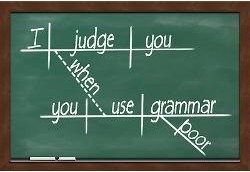
Sentence diagramming is really helpful. It’s also fun.
Mamacita says: I love a good turn of phrase. I can be swept off my feet by it. I can be swayed and influenced and converted and my vote can be purchased and my virginity can be compromised. . . .um, pretend you didn’t read that part. . . .
Language is power, and a pen is more powerful than any Ollivander wand. I love wit and whimsy and sarcasm. I love a quotation that knocks my socks off. I love WORDS. I love their meanings and their origins. I love how a word and a person both have histories. I love all the things that can be done with words. I love making them into adjectives and adverbs and nouns. I love the “kick” of a strategically placed interjection. I love how the  choice of a tiny preposition can change the focus of an entire book. I love how a comma can turn a legal contract into the opposite of what a careless reader believes it to be. I love dictionaries. I love to play with a thesaurus. I love the preciseness of grammar, and I love how that very preciseness gives us the ability to be witty, and whimsical, and how it not only lets our imagination soar, but also allows us to share what we discover as we soar. Figurative language depends on grammar for accuracy; metaphor, simile, hyperbole, alliteration, personification, etc., are awesome only if they’re done well.
Did I mention how much I love a clever turn of phrase? Literally and figuratively; I love words. You do understand the difference between literally and figuratively, don’t you? Of course you do. I’m going to assume that you do. Please don’t prove me wrong; it would be quite disillusioning. I’m counting on your refined inferential skills here.
Even more, I love how someone who KNOWS HOW can take that preciseness and twist it, toss it, and tie it into a knot. Good writers are a lot like good athletes; once they know the rules well, those rules can be twisted and turned into even more.
 More what? More of everything. There’s nothing in the rule book about Michael Jordan flying through the air like a veritable Peter Pan, but it wasn’t AGAINST the rules, either. Ditto a good writer.
Occasionally, too, a rule needs to be broken in order to make a point. This is true in business, as well, and also in our schools. A leader who doesn’t know when to break a rule is useless, and a writer who doesn’t know when (or how) to break a rule will not be as good a communicator as a writer who understands the language more thoroughly.
I love reading articles about people who are upset because their lack of grammar skills resulted in a lost court case, contract dispute, etc. Item: I am not on the side of the person who has chosen to become an adult without any honed grammar skills. I LOVE it when grammar-ignorant people lose.
One can almost always tell whether a piece of writing is written by someone who knows his/her grammar rules well and has chosen to twist them, or if a piece of writing is written by someone who is just plain ignorant.
Um, I teach writing. I love my job.
What I mean to say is, I LOVE MY JOB.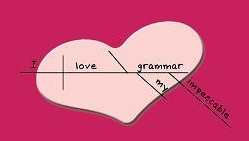
I hope you can tell.
P.S. Speaking of my vote. . . . I will generally vote for the candidate with the best grammar, my assumption being that the candidate with the best grammar probably studied everything else in more detail and depth, too. People with good grammar have paid attention. That’s been my experience, anyway.
P.P. S. If there are only two candidates, I’ll vote for the one with the better grammar. It’s that three degrees of comparison rule. . . . A political candidate who can’t put a simple sentence together probably won’t be any good at any other part of the job, either.
P.P.P.S. “Grammar” is spelled with an “-AR,” not an “-ER.” The word is “grammar,” not “grammer.” Unless we are speaking about your grandmother, in which case you should call her whatever she wants you to call her, and spell it however she dictates.
Or unless you are referring to Kelsey Grammer, but we are not discussing adultery in this post.
Fact vs. Opinion

Both statements here are fact.
Mamacita says: Fact vs. opinion is one of the units I look forward to, difficult though it can be for my students. Helping my students understand the difference between a fact and an opinion is one of the most difficult parts of my curriculum. We all want to think that what we personally believe is fact, and everything else is opinion. Until we learn discernment, we stand by “it” because “it” is what/how we were brought up and taught by our elders, and all-too-often, because it’s just how we want “it” to be and the thought that “it” might not is more than our level of discernment can bear.
We are raised in homes with certain values and while those values may be wonderful, and promote honesty and decency and learning, they are still opinions. Ditto the homes with values that promote lies and adultery and criminal behavior. Belief in both is opinion. I know which set of values I personally believe in, but that is my opinion. And yours.

A fact is a statement that is true and can be verified objectively, or proven. In other words, a fact is true and correct no matter what.
But no matter how firm we are in our beliefs, facts and opinions are not the same thing. There is a huge difference.

An opinion is a statement that holds an element of belief; it tells how someone feels. An opinion is not always true and cannot be proven.
“The garden has two rows of red tulips” is a fact. “All those tulips make the garden really lovely” is an opinion.
“Everyone should make a list before going to the grocery store” is an opinion. “Many people make a list before going to the grocery store” is a fact.
Pick and choose your words carefully; adjectives and adverbs can turn a fact into an opinion.
“My new boyfriend has gorgeous red hair” is an opinion “My new boyfriend has red hair” is a fact. One word can transform a fact into an opinion.
If a thing cannot be objectively proven, no matter how badly you might want to believe it’s a fact, it’s an opinion. Nobody controls facts. Nobody dictates truth. Not your mom, not your grandfather, not your minister, not your rabbi, not your priest, not your best friend, and not your president. Facts are. Truth is. Opinion varies.
Opinions are how you feel about it. Feelings are not facts.
Generalizations are not facts, either. If the statement uses words like “everybody,” or “nobody,” or “never,” or “always,” it’s an opinion.
“But Mom, everybody’s going to the party!” is an opinion. “But Mom, Mike and Sue are going to the party!” is a fact.

“Facts are the enemy of truth!”
In spite of Cervantes, facts are truth. (I will always love Cervantes’ quotation, though. Allegory fascinates me, and the Man of La Mancha is one of my favorite pieces of literature.) (And an awesome musical.) (Not the movie version; you have to see it live.) (My opinion.)
Facts and opinions clash all the time, and most of those clashes are nothing. (Big Macs are better than Whoppers – opinion. Big Macs don’t have tomato but Whoppers do – fact.) (Trivial fact that affects nothing important.) However, if religion or politics are involved, people tend to lose perspective and forget to be discerning. Or even how to count.
“The Baptist church is the only way to salvation” is opinion. “The Baptist church has the largest pipe organ in this city” is a fact, which can be proven with a tape measure. A really big one.
“Full immersion baptism is the only way to enter the Kingdom” is an opinion. “Many people believe that infant baptism is necessary for salvation” is a fact. Why? Because of the adjectives and adverbs. If an issue is important to you, analyze it carefully. Make sure it actually represents what you think it represents. Make sure it represents what you actually believe. For this, you need discernment.

Discernment is a learned skill that helps us understand the different between truth and lies, between fact and opinion.
Wishful thinking will not change an opinion into a fact. Word to the White House. There is no such thing as an alternative fact. Another word to the White House.
I know that much of life concerns the shades of gray that often lie between fact and opinion, but even so, an intelligent nation MUST know how to discern that.
Issues of any kind are clashes between fact and opinion. Please understand the difference. Not everybody loved Raymond. Don’t be afraid to challenge your belief system. If questions and banter and debate threaten to topple your belief system, maybe you need a new one. If you belong to any kind of organization that frowns on questions, run, don’t walk, away. They’re hiding something. They’re afraid of toppling.
Facts don’t topple. And nobody can say “because I said so” except your Mom, and that phase should be gone by the time you’re eight.

Not a good defense for anyone over the age of 8.
People with no discernment skills are easy to persuade, easy to boss around. They believe what they want to believe and they’ll follow anyone who advocates their same beliefs. They tend to be very literal. They are sheep, and sheep are stupid. Large mobs of sheep are dangerous. They want and even need to be led. They find leaders who are seeking these people. They want a leader who is persuasive and they’ll do almost anything asked of them. Remember Jim Jones? Beware.

DON’T DRINK IT!
People who know how to discern can be difficult in an environment that values obedience and kow-towing and instant belief. They know how to read between the lines. They comprehend inferentially as well as literally. They are thinkers and self-starters. They are creative and artistic and literate. They are the hope of the universe.
So, what’s the best way for a person to be? That would, sadly, be a matter of opinion. I hope mine shines through. I have no control over yours.
On the bright side, you have no control over mine, either. I know how to discern. Sometimes, after some thought, I change my mind. But never over a fact, my friends. 20 items means 20 items. If you have 21 items, you don’t belong in the short line. And that is a fact.
Discernment teaches us inferential skills, and context clues, because the same word in one context is a completely different word in another context. Super literal people have trouble understanding this. Lack of this skill is dangerous.
In common use almost every word has many shades of meaning, and therefore needs to be interpreted by the context. — Alfred Marshall
Remember third grade, learning how to use a dictionary, and how even tiny little simple words could have two pages of meanings, no two alike, depending on the context? And how you had to understand the context so you could understand what that little word meant this time when it meant something else last time?

Context is king.
That.
Our lives begin to end the day we become silent about things that matter. — Martin Luther King, Jr.
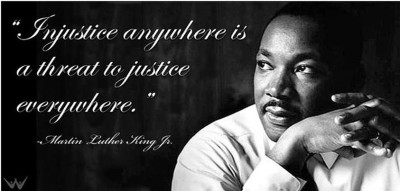 Mamacita says: Why is this day a holiday in most communities? (This community has only just recently started acknowledging MLK Day as a holiday; for years, none of our schools closed.) (They still don’t close for Veteran’s Day.) (The colleges, businesses, and guv’ment offices are closed – the public schools here are open.)
However, intelligent, sensitive, educated people understand that today deserves respect because a man who dedicated his entire life to peaceful means of acquiring freedom for all people fully deserves to be recognized, and there are still, shamefully, communities that do not consider this of any importance. Making it a holiday forces people to look at his name on their calendar, if nothing else.
If he had advocated violence, it would have been different. Violence does not deserve recognition. If he had advocated “something for nothing,” it would have been different. Bums do not deserve recognition.
But Dr. Martin Luther King advocated equal rights for all people, not just for whites and not just for blacks and not just for whites & blacks. He dedicated his life to gaining equal rights for EVERYONE.
And I can’t help but listen to a speaker with such beautiful grammar. His grammar enhances his message.
May we all have this same dream.
Careful, grammatically-correct language and an almost poetic speaking style will always get my attention. It’s an assumption on my part, of course, but I associate good grammar with people who actually know what they’re talking about. In fact, I am convinced that this is so.
Martin Luther King, Jr. definitely knew what he was talking about, and he knew HOW to present it.
====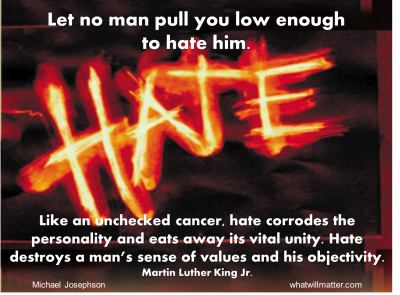
Darkness cannot drive out darkness; only light can do that. Hate cannot drive out hate; only love can do that. — Martin Luther King, Jr.
I have decided to stick with love. Hate is too great a burden to bear. — Martin Luther King, Jr.
The ultimate measure of a man is not where he stands in moments of comfort and convenience, but where he stands at times of challenge and controversy. — Martin Luther King, Jr.
Nothing in the world is more dangerous than sincere ignorance and conscientious stupidity. — Martin Luther King, Jr.
Our lives begin to end the day we become silent about things that matter. — Martin Luther King, Jr.
We must develop and maintain the capacity to forgive. He who is devoid of the power to forgive is devoid of the power to love. There is some good in the worst of us and some evil in the best of us. When we discover this, we are less prone to hate our enemies. — Martin Luther King, Jr.
The function of education is to teach one to think intensively and to think critically. Intelligence plus character – that is the goal of true education. — Martin Luther King, Jr.
A nation that continues year after year to spend more money on military defense than on programs of social uplift is approaching spiritual doom. — Martin Luther King, Jr.
He who passively accepts evil is as much involved in it as he who helps to perpetrate it. He who accepts evil without protesting against it is really cooperating with it. — Martin Luther King, Jr.
History will have to record that the greatest tragedy of this period of social transition was not the strident clamor of the bad people, but the appalling silence of the good people. — Martin Luther King, Jr.
Rarely do we find men who willingly engage in hard, solid thinking. There is an almost universal quest for easy answers and half-baked solutions. Nothing pains some people more than having to think. — Martin Luther King, Jr.