Randominities and an Actual Threat
I am of the opinion that it is not the responsibility of the laundress to turn socks and other articles of clothing right-side out.
I also believe that a hamper the size of a state park waste receptacle should be really easy to hit. That being the case, there should not be any piles of dirty clothing on the floor.
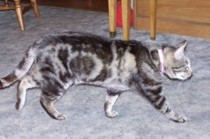
I have also come to believe that there is not a litterbox made today that is big enough to accommodate three teen-age female cats who are still pooping together approximately 49 times daily. Rubbermaid? A little help here? It’s hard for my girls to bury their poop when all three of them are trying to dig, dig, dig and cover at the same time. Hence the occasional tootsie roll that gets flung out of the box. I hate finding those.
Somehow or other, a bird got into the house the other night and the three cats went insane with joy. I felt bad for the bird, screeching like that for over an hour, but every time I tried to rescue it, I was attacked by three obsessed half-grown kittens who meant business.
Plus, the poor bird kept running underneath the furniture, and our furniture is HEAVY.
Finally, the screeching stopped and the cats came out from under the chair, mission accomplished.
Oh, they didn’t EAT the bird. They just wanted to mess with it. After it was dead, they just walked away and left it there underneath the heavy chair where I couldn’t get to it, and went downstairs for some CheapoChunx.
I seriously considered going to bed and leaving it for morning, but there was something about knowing there was a dead bird in my house that icked me out and I had to take care of it.
So, to get to it, I had to put the ottoman in the chair’s seat and move the weights to the side. Then I had to scoot the bass guitar and the electric guitar and the two banjos out of the path. Then and only then could I get in a position to pull the chair away from the wall. When the bird was exposed, I picked it up with a plastic bag and threw it off the back deck.
I don’t know what kind of bird it was before it was mangled, but it sure did have a looooong, sharp beak. I’m sorry, little birdie, but maybe next time you won’t fly into my house. Except there won’t be a next time, oopsie, what with you being dead now and all.
As for the guy who posted on his blog that I’m a bad person and a terrible teacher, and who also keeps telling me so in my own comments, and claiming he’s been banned for criticizing me, etc, listen up:
You put my link on your blog, sending all kinds of anonymous people here who hit me one swift low blow after another and slunk away, no contact information supplied.
I didn’t put your link here on my blog, but if you don’t stop with the insults, I will. One more insult. One more.
A critique and a string of insults are two different things. It would also help if you read that post carefully and realized its intention.
And just to help you out: When you mean “you are,” you need to put an apostrophe in your contraction. “Your” and “you’re” are two different things, too.
And surprise, I’m not mad at you. Thirty years ago I would have thought the same thing about a teacher who dared to speak up, because I would not have had enough experience to know how it was in most schools. A handful of years in one school isn’t enough to understand, hon.
Carry on. And please don’t put your dirty clothes on the floor beside the hamper, inside-out. Your mom has enough to do.
Nothing important is completely explicable.
A few, a very few, of my favorite Madeleine L’Engle quotations:
==
You have to write the book that wants to be written. And if the book will be too difficult for grown-ups, then you write it for children.
Our truest responsibility to the irrationality of the world is to paint or sing or write, for only in such response do we find the truth.
Inspiration usually comes during work, rather than before it.
We tend to think things are new because we’ve just discovered them.
We tend to defend vigorously things that in our deepest hearts we are not quite certain about. If we are certain of something we know, it doesn’t need defending.
I share Einstein’s affirmation that anyone who is not lost on the rapturous awe at the power and glory of the mind behind the universe “is as good as a burnt out candle.”
Infinity is present in each part. A loving smile contains all art. The motes of starlight spark and dart. A grain of sand holds power and might.
The world of science lives fairly comfortably with paradox. We know that light is a wave, and also that light is a particle. The discoveries made in the infinitely small world of particle physics indicate randomness and chance, and I do not find it any more difficult to live with the paradox of a universe of randomness and chance and a universe of pattern and purpose than I do with light as a wave and light as a particle. Living with contradiction is nothing new to the human being.
Truth is eternal. Knowledge is changeable. It is disastrous to confuse them.
Conversion for me was not a
I do not think that I will ever reach a stage when I will say, “This is what I believe. Finished.” What I believe is alive … and open to growth.
If it can be verified, we don’t need faith…. Faith is for that which lies on the other side of reason. Faith is what makes life bearable, with all its tragedies and ambiguities and sudden, startling joys.
What I believe is so magnificent, so glorious, that it is beyond finite comprehension. To believe that the universe was created by a purposeful, benign Creator is one thing. To believe that this Creator took on human vesture, accepted death and mortality, was tempted, betrayed, broken, and all for love of us, defies reason. It is so wild that it terrifies some Christians who try to dogmatize their fear by lashing out at other Christians, because tidy Christianity with all answers given is easier than one which reaches out to the wild wonder of God’s love, a love we don’t even have to earn.
We have much to be judged on when he comes, slums and battlefields and insane asylums, but these are the symptoms of our illness and the result of our failures in love.
In the evening of life we shall be judged on love, and not one of us is going to come off very well, and were it not for my absolute faith in the loving forgiveness of my Lord I could not call on him to come.
Those who believe they believe in God but without passion in the heart, without anguish of mind, without uncertainty, without doubt, and even at times without despair, believe only in the idea of God, and not in God himself.
Deepest communion with God is beyond words, on the other side of silence.
I will have nothing to do with a God who cares only occasionally. I need a God who is with us always, everywhere, in the deepest depths as well as the highest heights. It is when things go wrong, when good things do not happen, when our prayers seem to have been lost, that God is most present. We do not need the sheltering wings when things go smoothly. We are closest to God in the darkness, stumbling along blindly.
So I go to church, not because of any legalistic or moralistic reasons, but because I am a hungry sheep who needs to be fed; and for the same reason that I wear a wedding ring: a public witness of a private commitment.
Give the public the ‘image’ of what it thinks it ought to be, or what television commercials or glossy magazine ads have convinced us we ought to be, and we will buy more of the product, become closer to the image, and further from reality.
A great painting, or symphony, or play, doesn’t diminish us, but enlarges us, and we, too, want to make our own cry of affirmation to the power of creation behind the universe. This surge of creativity has nothing to do with competition, or degree of talent….This response on the part of any artist is the need to make incarnate the new awareness we have been granted through the genius of someone else.
…agape means “a profound concern for the welfare of another without any desire to control that other, to be thanked by that other, or to enjoy the process.” Not easy. But if we can follow it, it will mean that we will never exclude…It teaches me not only about forgiveness but about how to hope to give guidance without manipulation.
…when you put something into words, it leads to so many other thoughts.
Artists of all disciplines must be willing to go into the dark, let go control, be surprised.
I’ve worked with a lot of artists, and they all have a need that cannot be met by another human being.
The world is changing rapidly — that terrifies people. We know a great deal more now about the nature of the universe than we used to, which I think makes it all the more exciting. But change is frightening to people. And when you get frightened, you strike out.
It is far too easy to take refuge in our little groups, rather than allowing the Creator to change us as he changed Abraham, Isaac and Jacob.
The deeper and richer a personality is, the more full it is of paradox and contradiction. It is only a shallow character who offers us no problems of contrast.
My training in physics has taught me that there is no such thing as coincidence.
If I could comprehend God completely, God wouldn’t be worth bothering about. I’m finite, God is infinite; the finite cannot comprehend the infinite. But we get enough glimpses.
When I start a new seminar, I tell my students that I wil
l undoubtedly contradict myself, and that I will mean both things. But an acceptance of contradiction is no excuse for fuzzy thinking. We do have to use our minds as far as they will take us, yet acknowledging that they cannot take us all the way.
…this marvelous communal act – I wish I knew it more often in church, and that I were a less reluctant Christian. The church is too grownup for me, too reasonable, too limited.
The scientists think it likely that there may be other planets out there, but this far nobody’s been able to communicate with anybody else. Maybe we’d better learn to communicate with each other first.
So dis-aster is separation from the stars.
Nothing important is completely explicable.
There aren’t any easy answers to the questions being raised today, and it may be too easy for me to remember Jesus saying, “Greater love has no man than to give up his life for his friend.” Or wife, or children. Isn’t staying with your family sometimes a real equivalent of giving up your own life? Cannot it sometimes be a blessing, especially if it is given with graciousness, not rigid rectitude? I believe that it can, because I know of families where this is what has happened. Sacrifice is no longer popular, but I think that sometimes it can lead to true joy. Even the simplest of unions does not come free. There is always sacrifice.
The only God worth believing in is neither my pal in the house next door nor an old gentleman shut up cozily in a coffin where he can’t hurt me. I can try to be simple with him, but not vulgar. He is the mysterium tremendens et fascinans; he is free, and he understands the ousia of this frightened old child of his.
Trouble always comes whenever we begin to take credit for any of the gifts of the Spirit, be they gifts of prayer, tongues, prophecy, art, science….Modern medicine suffers, despite all its advances, because it has almost completely forgotten that healing is a gift as well as a science.
No wonder I yell for a God I do not understand in times of stress. Every time I’ve tried to depend on a human being it’s been disastrous.
I look at many of the brilliant, sophisticated intellectuals of my generation, struggling through psychoanalysis, balancing sleeping pills with waking pills, teetering on the thin edge of despair, and think that perhaps they have not found the answer after all.
I believe that consistently we need to look for good,and not for evil, that when we look for evil we call up evil, while heaven comes closer when we acknowledge it.
Love always has meaning. But sometimes only God knows what it is.
If we commit ourselves to one person for life, this is not, as many people think, a rejection of freedom; rather, it demands the courage to move into all the risks of freedom, and the risk of love which is permanent; into that love which is not possession but participation.
Six months after I started to write Wrinkle, I discovered higher math. And for me, higher math is much easier than lower math. Lower math lost me in 4th grade when I was taught that 0 x 3 equals 0. Now, I understand that if I have nothing and I multiply it by 0, 3 something’s are not going to appear. But, if I have 3 apples and I multiply them by 0, why are they going to vanish? So I wiped out lower math as philosophically untenable.
I also read quite lot in the area of particle physics and quantum mechanics, because this is theology. This is about the nature of being. This is what life is all about.
To put it into
I am still every age that I have been. Because I was once a child, I am always a child. Because I was once a searching adolescent, given to moods and ecstasies, these are still part of me, and always will be… This does not mean that I ought to be trapped or enclosed in any of these ages…the delayed adolescent, the childish adult, but that they are in me to be drawn on; to forget is a form of suicide… Far too many people misunderstand what *putting away childish things* means, and think that forgetting what it is like to think and feel and touch and smell and taste and see and hear like a three-year-old or a thirteen-year-old or a twenty-three-year-old means being grownup. When I’m with these people I, like the kids, feel that if this is what it means to be a grown-up, then I don’t ever want to be one. Instead of which, if I can retain a child’s awareness and joy, and *be* fifty-one, then I will really learn what it means to be grownup.
If it has to be “mine” it is an idol.
We cannot seem to escape paradox; I do not think I want to.
Those who do not believe in a loving God do not enjoy parties!
The way of peacemaking given us may be something so small that it seems hardly worth doing, but it is these small offerings which build our reflexes for the larger ones.
Play is part of intimacy, and in our busy world we don’t play enough.
We’ve become too polite. We don’t laugh and cry with God. We’ve forgotten the excitement of the Good News. What greater sign of the extraordinary, lavish marvelous love of God than the incarnation! God so loved the world and all of us in it that God himself came to live with us as one of us! Is it so good that we’re afraid to believe it?
“Prayer was never meant to be magic,” Mother said.
“Then why bother with it?” Suzy scowled.
“Because it’s an act of love,” Mother said.
Love isn’t how you feel, it’s what you do.
Love can often do peculiar things to senses of humor.
The house of God is not a safe place.
We’re right now at a new paradigm shift, and I don’t think any of us have really caught on to it, but it is far more terrifying than anything that
The glorious message of Scripture is that we do not have to be perfect for our Maker to love us.
In
It has only recently struck me that we need our shadow-casters, metaphorically as well as physically. What in me casts shadows, and what kind?
Sometimes when we have to speak suddenly we come closer to the truth than when we have time to think.
I believe that people become trusworthy only by being trusted…..When we fall as we always do, we pick ourselves up and start again. And when our trust is betrayed the only response that is not destructive is to trust again. Not stupidly you understand, but fully aware of the facts, we still have to trust.
When we make ourselves vulnerable, we do open ourselves to pain, sometimes excruciating pain. Th
e more people we love, the more we are liable to be hurt, and not only by the people we love, but for the people we love.
Because you’re not what I would have you be, I blind myself to who, in truth, you are.
Schooling, instead of encouraging the asking of questions, too often discourages it.
It’s a good thing to have all the props pulled out from under us occasionally. It gives us some sense of what is rock under our feet, and what is sand.
That’s the way things come clear. All of a sudden. And then you realize how obvious they’ve been all along.
But you see, Meg, just because we don’t understand doesn’t mean that the explanation doesn’t exist.

Madeleine L'Engle, 1918 – 2007
Madeleine L’Engle has died. She was my favorite author.
Her books were about me.
Kids who were a little different. Kids who were a little smarter. Kids who had insights. Kids who were misunderstood. Kids who realized at a very early age that their teachers did NOT know everything. Kids who felt alone. Kids who found friends who were also different, smart, and insightful. Kids who loved science but hated science class. Kids who hated math class but intuitively understood that math was all around us. (Meg is a mathematician! How many YA books feature a female mathematician?) Kids who wanted to learn about Madame Curie and Einstein and Planck but who were required instead to read about how the moon has phases, in language so simple that we knew it was meant for kids who didn’t already know all about the moon’s phases, at an age when NOT to have known that already should have been shameful. Instead, it was considered typical, and we were not.
Her books were banned in many localities; naturally, by “concerned parents and clergy” who had never read them. This only increased the books’ appeal, at least for smart people.
Yes, many kids could not understand them. Why was that a bad thing?
Well, it mean that many kids didn’t have the capacity for understanding anything that wasn’t written at a third grade level, but none of you will be very surprised to know that I consider that mainly a thing the kid himself/herself needs to work on.
Not to be curious about or have intuitive knowledge about the “things unseen” is a tragic thing.
As for people who advocate censorship, well, there are many words to describe these people, all of which can be found in any thesaurus if you look under “stupid.”
People who advocate censorship don’t generally come here, unless they wish to be abused. 🙂
I’ve read what the censor-mongers have to say, and none of it is viable. Please, don’t any of you fall for that absolute nonsense.
Yes, I generally read up on both sides of any issue I feel strongly about. How else can one come to a logical conclusion? One side of an issue isn’t ‘facts.’ One side of any issue is merely propaganda.
Madeleine L’Engle’s books were wonders of literature and every other “subject” imaginable.
Madeleine L’Engle knew how to turn magic into science, without losing any of the magic.
This is, of course, a talent that all teachers should have. Many teachers know how to teach science, but their methods and prescribed curriculi target the magic and intentionally remove it.
This applies to all subjects.
I loved Madeleine L’Engle and all of her characters, most of whom were Madeleine herself. She even taught me how to love unsavory sniveling characters who symbolized all that is wrong with the world.
She taught me to accept no excuses for negative behaviors, but to always seek the reasons behind them that we might try to help people who do terrible things.
She taught me that everyone has reasons for what they say and do, even when they themselves do not understand those reasons.
She taught me not only that love is the answer, but that love has many faces. And phases.
She taught me that an inability to comprehend far-reaching consequences is one of the biggest problems we as a civilization face. Her books show us that selfishness can destroy others as well as ourselves.
Her books tell children that there are people like us all over the planet, who know about the magic behind a lot of the daily drudgeries we must all get through. Longing for a family like the Austins or the Murrays got a lot of my students through childhood and adolescence, with the determination that they, like Calvin O’Keefe, would someday escape the horror that was their biological family and create a REAL family, and that sometimes one’s REAL family is as unlike one’s biological family as anyone could possibly imagine. These books taught, and still teach, children to keep hoping, that things WILL get better if each person believes it will and works to make it so.
These books teach us that if we wait and work and strive and refuse to give up, we can change our own world which, of course, changes the whole world.
Thank you, Madeleine. I’ve loved you since the day I discovered that first book, and I’ve loved you more with each additional discovery.
You made the world better. I’ll miss you. Thank you.
Thank you so very, very much.