
Thises and Thats, Pt. 9
After several months of freakish spring-like temperatures so warm that the trees got confused and tried to bud, we’ve finally got winter here in southern Indiana. It’s 15 degrees and getting colder, and it really makes me wish we’d gotten the chain saw fixed so we could have cut up the big tree that fell down in the back yard in a windstorm two years ago. Tonight is a woodstove night. Well, actually, it’s a woodstove full of wood night. See how important one small element can be? Half is not good enough. Even with ten points thrown in for self-esteem purposes, 60% of this equation isn’t going to put a fire in a woodstove. The woodstove doesn’t care who you are or who you know, either. Sigh. Brrrrr. We’re too broke cheap to move the thermostat from the 65 degree setting it’s so used to in the winter, so there’s nothing to do but put on some warmer and more sensible clothing whine.
Hub goes back to school tomorrow. I go back on the 14th. Yay, college!
I fully intended to take down the Christmas tree yesterday, but it was just so beautiful glowing and twinkling there in the big window, and I was sewing and looking at it and at my magic and mindbogglingly awesome wireless digital picture frame on the table next to it, and the next thing I knew it was four in the morning and who wants to take down a Christmas tree at four in the morning?
I can’t take it down tonight, either, because, well, we’re still looking at it.
The people down the road who decorated their home like a gingerbread house haven’t started to take theirs down yet, either, and I don’t want to give them any ideas. I love driving past that house; it’s absolutely gorgeous. I just know that Hansel and Gretel are in there somewhere, Gretel slaving in the kitchen and Hansel in his cage being fattened for the witch’s dinner. . . .
My sentences are not abiding by the parallel structure rules, but I’m off duty until the fourteenth.
Later tonight, I’m going to make a lot of fudge to send to my brother. I can’t do it now because the only pan I own that’s big enough is in the dishwasher, and I have to wait for the cycle to finish. If you go to Idaho State and know my brother, please don’t tell him he’s getting a big package full of fudge in a week.
For the past thirty years we have spent New Year’s Eve with our best friends, and this year was no exception. Janice the Menopausal Loan Officer and her hubby are just simply the greatest.
I’ll be spending the weekend with my Tumorless Sister and some mutual friends, and I’m looking forward to that very much. My sweet little niece is having a belated New Year’s party and I’m looking forward to that, too.
This has been a lovely holiday season; we did nothing extravagant or large, but we gathered with family and friends and we’re still gathering, and most of our best memories are made up of little things, which are, of course, really big things in disguise.


. . . And A Right Guid Willie Waught To You All

I hope all of you have a wonderful and positive New Year. I hope nothing bad happens to any of you, and I hope you are all safe, and healthy, and happy, every single day. You, and everybody who is precious to you.
Did you know that the automated Times Square dropping ball was invented by a teenager, by the way? This teenager has become a very amazing adult, responsible for many innovative inventions and wonderful ideas and brilliant concepts. We study Dean Kamen in my college reading class.
This song, which all of us will be hearing and maybe even singing tonight, always makes me tear up. Even back before I knew what it meant, something about it was both sad, and happy, and sentimental.
It also makes me think of When Harry Met Sally, which is and always will be one of my favorite movies of all time.
What does this song really mean? I think it’s important that we all know, since it’s a song that’s become a kind of holiday icon for most people. When you sing or hear it tonight, think about what the words are saying.
Auld Lang Syne
Should auld acquaintance be forgot, (Should old acquaintances be forgotten,)
And never brought to mind (And never remembered?)
Should auld acquaintance be forgot,
And the days of auld lang syne. (And days of long ago.)
And surely ye ‘ll be your pint’ stowp (And surely you will pay for your pint)
And surely I ‘ll be mine (And surely I’ll pay for mine)
And we ‘ll take a cup o’ kindness yet (We’ll drink a cup of kindness yet)
For auld lang syne (for the days of long ago.)
We twa hae run about the braes (We two have run around the hillsides)
And pou’d the gowans fine (and pulled the daisies fine)
But we ‘ve wander’d monie a weary fit (But we have wandered many a weary foot)
Sin’ auld lang syne. (Since the days of long ago.)
We twa hae paidl’d in the burn (We two have paddled in the stream)
Frae morning sun till dine (From noon ‘till dinner time)
But seas between us braid hae roar’d (But seas between us broad have roared)
Sin’ the days of auld lang syne (Since the days of long ago)
And there’s a hand, my trusty fiere (And there’s a hand, my trusty friend)
And gie ‘s a hand o’ thine (And give us a hand of yours)
And we ‘ll tak a right guid-willie waught (And we will take a goodwill draught)
For auld lang syne (For the days of long ago)
[CHORUS]For auld lang syne, my dear (For the days of long ago, my dear)
For auld lang syne (For the days of long ago)
We’ll tak a cup o’ kindness yet (We’ll take a cup of kindness yet)
For auld lang syne (For the days of long ago.)
To answer the question of whether or not old acquaintances should ever be forgotten, the answer is, most emphatically, “NO.”
Not till the Alzheimer’s makes me say “Oh Baby” to the nursing home orderlies.
I love you, dear friends. And I wish you were all here so we could take a right guid willie waught together. I’m really up for some good willie waught.
Have a wonderful and safe New Year’s Eve. Let’s all still be here New Year’s Day. I don’t want to hear of any wonky driving from any of you, you hear?
Happy New Year to you all.
It Don't Mean A Thing If It Ain't Got That Zing
 Fair warning: Long rambling rant ahead.
We can’t really appreciate something unless we notice it. It’s hard to notice something when it’s surrounded by lots and lots of other somethings. When there are too many, no matter what there are too many of, we tend to take them for granted and even resent them. Think “dandelions.” A few are things of beauty, but too many are weeds, all alike and indistinguishable from one another. Tis thus with “children,” too. Another book I often quote, “A Tree Grows in Brooklyn,” describes children this way:
(Katie’s baby is sickly, and an old woman has told her it would be better off dead.)
“Don’t say that,” Katie held her baby tightly. “It’s not better to die. Who wants to die? Everything struggles to live. Look at that tree growing up there out of that grating. It gets no sun, and water only when it rains. It’s growing out of sour earth. And it’s strong because its hard struggle to live is making it strong. My children will be strong that way.”
“Aw, somebody ought to cut that tree down, the homely thing.”
“If there was only one tree like that in the world, you would think it was beautiful,” said Katie. “But because there are so many, you just can’t see how beautiful it really is. Look at these children.” She pointed to a swarm of dirty children playing in the gutter. “You could take any one of them and wash him good and dress him up and sit him in a fine house and you would think he was beautiful.”
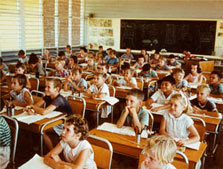
It’s hard to see individuality in a swarm. It’s hard to see beauty in a crowd. It’s difficult to notice differences when the numbers are overwhelming. When a classroom is overcrowded, it’s impossible to give each student the attention he/she not only deserves, but NEEDS. When there are too many, only the loudest, the most disobedient, the worst behavior problems, and the squeakiest wheels get any attention. Little quiet well-behaved students are ignored. They’re appreciated, when the overworked and overwhelmed teacher gets a chance to catch his/her breath and think about it, but ultimately there is just no time left over for a child who doesn’t “demand.”
a reasonable amount of just a few students.
Who is writing these scripts? The only ones I’ve ever seen were lifeless, insipid, boring, uninspiring drivel, aimed at – who else? – the lowest common denominator in the classroom. If they were properly written, it might work.
I hate it that so much of every school year is devoted to reviewing those things that were supposed to be covered and learned in years past. So many students got it then, but they still have to participate in reviews year after year, instead of being allowed to take the prior knowledge and run with it. NOT FAIR.
There is entirely too much review in many of our schools.
If you help the chick hatch, it will die. If the chick has to struggle and strive and remember and work – its OWN work, it will thrive. Many of our schools, these politically correct times, are so concerned with self esteem and never taking chances and never comparing and never competing and never having winners or losers (we’re ALL winners here!) (horse-hockey!) and never keeping score and never excluding anybody for any reason, they’ve forgotten what a school is actually for: to help students learn how to read well and write well and figure well, and learn about the past so they can a
pply it to the present and the future, to learn to think clearly and appreciate good books and memorize things and be exposed to all kinds of things the child can’t begin to understand yet but will at some future date. Those sudden “Wow!” moments, when we don’t understand something and then we do, are priceless. Our curriculum takes most of those moments away, because schools are obsessed with immediate understanding and measurable results.
I’m all for measurable results, but many of the most important things can not be measured.
When there are too many children in a classroom, it’s not possible to do much more than measurable standardized stuff. There is no magic. There is no wonder. There is no imagination. Yes, before anyone can really soar, he/she needs to have a core of basic knowledge with which to work, but honestly? I think that if our kids had the prospect of magic and wonder, they might be more interested in earning the right to go there via mastering the basics. Mastery should mean privileges. Non-mastery should not. Again, these things are more easily accomplished with smaller groups.
If your child is one of an overlarge group in his/her school, don’t let a week go by without asking the principal, the superintendent, the school board, when those numbers will become workable. Don’t take “no” or “later” or “budget problems” or “Sadly, not this year” or ANYTHING for an answer. Keep at it. Go public. School superintendents fear publicity. Write letters to the editor, comparing the empty library shelves and 35+ in the second grade classroom to the luxurious athletic bus and the brand-new gym built so ten or so kids can strut their stuff. Find out how many kids don’t have books because the school didn’t buy enough, and tell everybody. Get a visitor’s pass and ask to tour the school; pay close attention to classrooms stuffed so full of desks there is no way anyone could possibly walk around in the room, including the teacher. Look to see if the teacher has a desk; often, the teacher’s desk is removed to make room for more student desks. Don’t ask for average class sizes; my daughter’s third grade classroom had 36+ students in it, while in town, no third grade classroom had more than fifteen. One town school had three third grade classrooms of twelve students each. The average, on paper, looked really good. The reality was, in our little country school – part of a large consolidation – the parents didn’t know they had the right to ask questions; they just accepted. This is not ethical. It’s legal, but not ETHICAL. Ask how many students are in the classroom. This is public information and you have a right to know.
A teacher and fifteen students can accomplish so very much more than a teacher, an aide, and 38 kids. I have long believed that many schools “include” students so they can pay one teacher’s salary, one minimum-wage aide’s salary, and not have to hire another teacher. And unless inclusion is done properly, nobody benefits except the corporation budget controller.
Any time a child is forced to sit in a classroom so crowded that all the faces start to look alike, and all the names just kind of run together, and all the eyes start to shine less each day, and all the hands that would like to rise in the air and answer remain listless because who’s going to see in that sea of other hands, it is long past time to protest.
One dandelion is beautiful. It’s a flower, and a flower so attractive, people would buy them in nurseries and set them out in rows and make borders with them. It is only their commonness and their numbers that make them such nuisances, and make people want to negate their status as genuine flowers and instead treat them as usurpers and parasites.