

Beware the Ides of March

Beware indeed.
Mamacita quotes from Shakespeare’s Julius Caesar: Act 1, scene 2, 15–19
Caesar: Who is it in the press that calls on me?
I hear a tongue shriller than all the music
Cry “Caesar!” Speak; Caesar is turn’d to hear.
Soothsayer: Beware the Ides of March.
Caesar: What man is that?
Brutus: A soothsayer bids you beware the Ides of March.
And what, pray tell, are the Ides of March, that Caesar needed to be warned against them? Should we all beware the Ides of March? What are Ides?
There is no reason for any of us to beware the Ides of March. Or the Ides of May. Or the Ides of October. Or the Ides ol July. All months have Ides; however, the rest of them have Ides on the 13th of the month. But I digress.
The Ides of any month are simply the 13th or 15th of the month. (see above.) The soothsayer was merely warning Caesar that something bad was going to happen on March 15. Caesar had already had other warnings – one from his wife! Caesar was very superstitious and took the warning seriously; however, this didn’t prevent him from leaving the house on March 15 anyway and walking out into the public forum. What could possibly happen? All his best friends would be there! So he walked out of the house and into the forum. . .
. . . . where his best friends were waiting for him with daggers, whereupon they jumped him and stabbed him to death. For his own good, and for the good of Rome, they believed.
Caesar was just too ambitious, they thought. So, rather than risk his rise to power and popularity, they offed their best friend.
Caesar, Brutus, and Cassius – the three musketeers, the Bobbsey triplets, the inseparable pals. Caesar trusted them; he loved them; they were his friends.
Which is why, when Caesar saw who was attacking him, he cried out, in disbelief, “Et tu, Brute?” Which means, simply, “Even you, Brutus?”
But Brutus and Cassius, and the others, had realized that their pal Caesar was a little too cocky for Rome’s own good, and when even one’s best friend brags in public that he was as elite and cool as a god, one must do something to protect the nation. Remember your mythology – every time a mortal bragged that he or she was like or better than a god or goddess, bad things happened to him/her. Really bad things.
“Beware the Ides of March.” And now you know what that means, and why Caesar was warned to be careful of that day.
It was, like, you know, cuz the soothsayer somehow knew that Caesar’s dearest and most beloved friends had had enough of his bragging about his coolness and were going to take him down. And they did.
But even when I was a kid and first read that scene, something inside of me SAW the expression on the man’s face when he realized that his best friend in all the world had stabbed him in the back. It was a heartbreaker.
And now you have a perfect example of another expression. Backstabber. Stabbed in the back.
Shakespeare is so awesome; I loved the language even as an elementary student. It’s exactly the same language that you’ll find in the King James Version of the Bible, which I also love.
Perhaps one of you can also answer a question that has puzzled Shakespeare fans for years: Why in the world did the man bequeath his second-best bed to his wife?
I tend to agree with Jane of Lantern Hill, who was of the opinion that “Perhaps she liked it best.”
P.S. Don’t be afraid of the language. Relax, and try to see the poetry and the amazing graphics in Shakespeare’s witty turn of phrase. It’ll knock your socks off, if you let it.
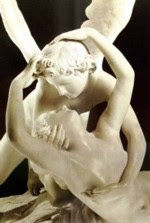
Cupid and Psyche

Mamacita says: It’s Valentine’s Day, and since many people associate this day with Cupid, let’s talk for a moment about the REAL Cupid. Well, the real mythological Cupid.
Cupid is not a fat naked baby, flying around shooting arrows into people to make them fall in love with the first living thing they see, causing people to have inappropriate relationships with cows and bulls and goats. It was used as an excuse by some people, but we won’t go there.
It’s kind of along the same lines as the alcoholics who tried to rationalize their choices by swearing they were just worshipping Bacchus/Dionysus, and the knocked-up teenagers who swore they were abducted by Zeus. . . .
Ahem.
In some myths, Cupid IS a perpetual child, but in most of the myths, he is as all the other gods (except Hephaestus) were: indescribably beautiful. Unfortunately, his mother was the goddess Aphrodite/Venus, and even though she was the goddess of love and beauty, she was a BITCH.
Here is the story of what happened when Cupid dared to fall in love and try to have a life of his own. Heh, and some of you think YOU have mother-in-law problems. . . .
==
Once upon a time – was there EVER a better way to begin a story? – there was a King who had three daughters, all beautiful, and the youngest daughter was the most beautiful of all. In fact, and this was dangerous talk in any myth, people said that this young princess was more beautiful even than the goddess of beauty herself. Now, whenever, in a myth, people compare a mortal to a god or goddess, you will know in advance that the poor mortal, even though he/she probably did nothing wrong, is going down. DOWN. Circling the drain down.
This young princess, whose name was Psyche, begged the populace not to say such things, but people were heedless and full of gossip even back in these days, and the talk went on and on. Eventually, of course, Aphrodite heard of it, and she was FURIOUS.
She called her son Cupid to her, and instructed him to fly down to earth and shoot an arrow into Psyche, making sure the first living thing she saw would be a monster that would devour her even as she could not help falling in love with it.
What Aphrodite had not foreseen was this: Cupid took one look at Psyche, was dazzled by her beauty, tripped and fell on one of his own arrows and fell in love with her himself. It was the real thing, too; it would have happened with or without magic love arrows or anything else. He saw her, and he loved her.
He knew, though, that he would have to keep it a secret from everyone, especially his jealous, possessive mother. Therefore, he would have to somehow get Psyche away from her family and sneak her to his palace.
He sent Psyche’s father, the King, a dream that directed him to go to an Oracle – a fortuneteller – who told him that he must take his beloved daughter to the top of the mountain and let a Demon take her to wife.
The King did not dare to disobey, so he and Psyche’s sisters walked with Psyche up the mountain and left her on a jutting rock to await her demonic husband. She did not understand what was happening, and could not think why she should be treated so, but back in the days of the myths, people did what the gods told them to do and chalked it all off to the Fates.
That night, the West Wind swooped down and flew with her to her new husband’s home. She tried to ask Zephyrus what was to become of her, but he would not, or could not, answer. He, too, was following orders.
To Psyche’s surprise, Zephyrus took her to a beautiful palace, even more beautiful than her father’s palace back home. Invisible servants waited on her hand and foot. Delicious food was served to her, three times a day. Lovely clothing appeared in her closet.
She dreaded the night, because she knew that her new husband would come to her in the marriage bed, but when he came into the room, she knew no fear. She could not see him in the dark, but he told her he loved her and would always love her. He also told her that she must NEVER see him in the light.
He came to her every night after dark, but was gone before the morning light fell upon his face. Psyche knew that she loved him, but she did not even know his name.
Then, she got homesick.
After much crying and begging from his wife, Cupid told her that her two sisters would be allowed to visit her. Psyche was happy to hear this, for living alone in a huge castle with only invisible servants by day and a nameless, faceless husband by night was hard on a girl. Besides, she was pregnant.
Cupid was happy to hear this news, but he warned his wife that as long as she never looked upon her husband’s face, the baby would be immortal, but if she could not resist temptation and saw him in the light, the baby would be mortal and eventually die.
By this time, Psyche loved her husband so much she would have done anything for him. She agreed.
When her sisters arrived, they were impressed with the richness and luxury their sister enjoyed, but their jealousy of her good fortune overcame their love for her. They were amazed that Psyche was pregnant with the child of a husband she had never seen and didn’t even know by name. They told Psyche that he must be a hideous monster, and that she had a right to see her husband’s face. They told her that if he was indeed a monster, she would have to kill him. They told her these things over and over until they convinced her that it would be the only right thing to do. After all, why should a wife not know her husband’s face and name? It was so logical!
That night, after her husband had come to her and then fallen asleep, Psyche fetched an oil lamp and a knife. The lamp would show her his face, and if he was indeed a monster, she would kill him with the knife.
But she trembled, and a drop of hot oil fell on him. He awoke, and turned to look at her. She saw, in the light, not a hideous creature from the depths of hell itself, but a beautiful young man with golden wings, looking at her with love and pain and despair. He got out of bed and flew away, and Psyche knew she would never see him again.
Psyche blamed herself for losing her husband. Because of her curiosity and disobedience, she was alone, and pregnant. She prayed desperately to the gods, but they did not answer, and Cupid did not return to her.
She decided to go to Aphrodite, Cupid’s mother, and offer her services as a servant, hoping that Cupid might admire her devotion and return to her.
What naive Psyche didn’t know was that her mother-in-law didn’t merely dislike her; she HATED her, and was eager to do great harm to her to keep her son away from his wife. She was still angry because the townspeople in Psyche’s homeland had remarked that Psyche was more beautiful than Aphrodite, and the fact that this girl was now pregnant with her son’s child made Aphrodite even more furious. Aphrodite was determined to punish Psyche for taking some of her son’s affection from his mother.
Aphrodite set Psyche to work on a series of ridiculous, impossible tasks. She had to sort a roomful of different grains by nightfall; had it not been for the ants, who helped her sort the grains into various piles, she could never have finished. Next, Aphrodite told Psyche she had to shear the wool from a flock of deadly, possessed sheep that were hypnotized, so that they tried to kill all who came near. Fortunately, the reeds along the riverbank advised Psyche that she could get enough wool from the thorny bushes the sheep had passed through, instead of trying to deal with these evil sheep.
Each time Psyche succeeded, Aphrodite became angrier and more determined to break her. The tasks became more and more difficult. She sent Psyche to fetch water from the river Styx, the river of death, but fortunately, Zeus took pity on Psyche and sent one of his mighty eagles to fetch the water for her.
Finally, Aphrodite told Psyche to enter the Underworld and fetch her box of cosmetics from Persephone, Queen of the Underworld. No mortal had ever entered the World of the Dead and returned. The night before this task, she lay in her bed and wept.
Suddenly, she heard a voice, telling her how to succeed in this task, and also warning her not to open the box once she got it in her hands. This piqued Psyche’s curiosity.
In a myth, whenever someone is extremely curious about something, there’s going to be trouble.
Psyche entered the Underworld. She crossed the Styx, paying Charon his toll. (This is why, in many cultures even today, the dead are buried with a coin on each eyelid.) She gave food to Cerberus, to distract him so she could run through the gate of Hades. (Meat is placed in the hands of the dead, and when rigor mortis set in, the meat was secure in the fist.) Psyche did as the voice had instructed her throughout her entire visit, and finally, box in hand, she returned to the world of the living.
Once she got back to her palace and was alone with this mysterious box, Psyche’s curiosity got the better of her. What harm could one little peek do? She wasn’t going to TOUCH anything in there, after all. But when she opened the box, she fell into a deep slumber.
By this time, Cupid’s anger had passed, and he longed for his wife and baby. His mother tried her best to dissuade him, but for the first time in his life he defied her openly and, in spite of her magical attempts to hold him, flew out of his childhood home and went back to the castle he had built for his own family.
He found his wife, sound asleep on the floor of her room, and so deep was her sleep that Cupid thought she was dead, and wept as he held her in his arms. He bent to her for one last kiss, and she awakened!
Cupid and Psyche were together at last, in the light, and both liked what they saw.
However, there was still the danger of Aphrodite, who still hated Psyche and who wanted her son Cupid’s full devotion. Cupid finally appealed to Zeus, King of the Gods, and asked him to make his wife immortal, that Aphrodite could no longer harm her, and Zeus agreed.
Cupid and Psyche lived happily ever after, and their daughter Volupta. . . well, that’s a whole other story, isn’t it.
==
I hope you saw the roots of a lot of fairy tales and other stories. The ancient myths are a treasure trove of literary points of origin. I also hope you noticed a lot of root words; the English language is a patchwork quilt of languages: we steal from everybody.
Mythology is one of my thangs. Can you tell?
Happy Valentine’s Day, all.
Somebody else can tell the story of St. Valentine. I like Cupid and Psyche.
This myth is also ONE of the origins of the expression “Opposites attract.”
Because Love is all emotional, see, and the Mind is logical, and. . . . oh, you know. And how ironic is it that the Ancients saw the male as the emotional one and the female as the logical one?
Mythology is so cool.
 Mamacita, Scheiss Weekly

Show and Tell

Mamacita says: Many years ago, I was teaching Public Speaking in a small farmland high school in southern Indiana. My students’ assignment, one week, was to give an informal “how-to” presentation, a brief demonstration of something they personally knew how to do.
That week, we all learned how to crochet a chain stitch, how to do macrame, how to carve a simple wooden toy, how to change a tire, how to juggle, how to put a belt on a broken vaccuum cleaner, how to put a zipper in a skirt, how to make various color combinations of Easter egg dyes with food coloring and vinegar, and how to make homemade ice cream.
We also learned how to put a suppository up a cow’s butt, how to take a horse’s temperature with a rectal thermometer, and how to neuter a bull calf.
It was a really interesting week. I’ve never been able to look at a rubber band or a razor blade the same way since.