How We Spend Our Days Is, Of Course, How We Spend Our Lives *
Mamacita says: “Why not go out on a limb? Isn’t that where the fruit is?” –Frank Scully
I’ve always liked that quotation. I also believe it is absolutely true. I think about it whenever I’m feeling particularly cowardly. It helps me overcome it. Words help me overcome it.
I’ve always stood in awe before the power of words.
With words, simple words, we can delve into the past and the future, and all the various time blends that scientists must use big words to explain, but which writers can explain simply by using one or two of the helping verbs Ol’ Miz Roberts made us memorize back in seventh grade.
Time machines in stories show the blending of times with numerals and fast-motion, whipping past the window of the machine, or by numbers going backwards or forwards on a dial.
Writers just use a helping verb or two.
Scientists discuss the concept of time, past time, present time, future time, using diagrams and equations and big, big words. Writers just stick a “have” or “had” or a “will” in front of a plain old verb to show the same thing.
Past and future are the easiest to measure. They are also the easiest to understand, or comprehend. “Already happened” and “not happened yet” are no biggie.
It’s the present that’s the most difficult to comprehend and measure, because even with all of our scientific knowledge, inventions, devices, equations, whatever, the present is too fleeting to measure. The actual ‘present’ is so fleeting, we can’t even realize it ourselves. By the time we do, it’s already gone. Blink, and it’s past. Breathe, and it’s past. Sit still; each beat of your heart is in the past, because by the time you are aware, it’s too late, it’s gone.
Look at your children. They’re in the present, sure, if you want to call it that. Watch them sleeping. Each rise and fall of the covers is already part of the past. History. It’s already happened, and it will never happen again. Not that particular breathe. Not that particular heartbeat. Watch them play; this moment will never come again. Look at the pictures you took only a few seconds ago. Those moments are gone. The expression on your child’s face, the way his hair falls over his eyes when he’s played outside for a while, the Kool-aid smiles, that particular shirt. . . Gone.
So often we say that we can’t WAIT for a particular phase or week or school year, etc, to be over with. Be careful what you wish, my dears. . . . When it’s gone, it’s gone. My mom used to tell me – usually in the midst of a particularly awful phase – not to wish my children’s lives away, but I didn’t understand what she meant then. I do now.
The actual present can’t be measured, not by us, not yet. Use it carefully, for once you’re aware of it, it’s already part of your history.
And your history, and mine, are, of course, part of the history of mankind.
Ah, the power of words, that we can so clearly express the elements of time with just a few simple helping verbs. Scientists can’t do it yet. Only writers can do it, with our magic wands called pens. The typing fingers of a writer can make the past come alive again, and the present seem permanent, and the future? A time of hope and joy, which I hope is true for all of us.
I wondered about it. (simple past: one-shot deal, it’s over.)
For many years, I have wondered about it. (present perfect: I was wondering in the past and I’m STILL wondering. Two times are represented here, one in the past and one in the present.)
I had wondered about it before I said something. (past perfect: both actions are in the past, but one is more recent than the other. Two times are represented; both past.)
I have always enjoyed teaching this concept, and with adult students, it’s even more awesome. I’ve had students weep, during this lesson.
Words are powerful. A pen in the hand is power. Use words carefully, and properly. Choose them wisely.
Remember, there’s a big difference between a wise man and a wise guy. And which would you prefer: a day off or an off day?
I love the power, magic, and majesty of words. Maybe this is one reason I hate texting and cutesy codes so thoroughly
U dig?
*Annie Dillard

Happy Father's Day, Daddy
 Mamacita says: My father died several years ago: a long, slow, drawn-out process that left my mother and my siblings and me drained and sad, and grateful when the final ending finally ended. I loved my father, with all his faults, and charms, and whimsicalities, and more faults, and understanding, and lack of understanding, and singing, and poetry, and callousness, and sensitivity, his sense of humor, his hilarity, his faults, faults, faults, his betrayals, his loyalties, his insensitivities, and many other words, many contradicting the one before, and all absolutely true.
I’ve posted a lot in the past about my dying father: blind, both legs amputated above the knee, on kidney dialysis, eating via a stomach tube, etc. That was an accurate picture, but it wasn’t the only picture. It is also not the picture I have in my mind’s eye when I think of my father. At least, not usually.
My father – my REAL father – the father who was intact, before the diabetes devoured him, was tall, and strong, and hilarious. He was handsome – Hollywood handsome. He liked new experiences. He liked to travel. He sang. He cracked terrible jokes. He read voraciously. He was smart – really, really smart. He would have liked to have gone to college, but it wasn’t possible. Instead, he sent four kids through college, and continued to work day after day in a factory “so we would never have to.” He tried hard, and he did the best he could with what he had.
Dad wasn’t perfect, not by a long shot. He and all of his brothers and their father before them were quick-tempered and easy to, as Mom used to say, “set off.” My Other Sister and I had a daddy who was playful and laughing. My two younger siblings had a daddy who was cranky and yelling. Dad’s illness began long before anybody realized it, including himself, and the personality changes were just brushed aside as part of the aging process or, possibly, his true colors. Nobody actually said “true colors, ” but we all thought it.
It wasn’t until both of dad’s legs had been amputated and he was blind and bedridden and too weak to feed himself or turn over, that we all realized that the diabetes had begun to affect his mind long before it took his body.
He stayed at home and Mom took care of him. I don’t think she went anywhere for three or four years, except her hasty runs to the grocery and drugstores while Dad was at dialysis.
As I said, he was a fantastic father to his older children. With the younger kids, his various illnesses had started to affect him, and things in the house were different. Some of it wasn’t his fault, and some of it was. In this way, he was no different from any of us. Whatever may have crossed his mind from time to time, he never entertained the thought of leaving his family. I’m sure he was tempted to, as who isn’t? In fact, we KNOW he was tempted, but he had made a promise and he kept it. In my parents’ home, promises meant something.
On Father’s Day, I will think of my father with love and a few head-shakings and a lot of forgiveness and smiling. And, a few things that I haven’t forgiven yet.
Happy Father’s Day, Daddy. I knew all along that mean yelling daddy wasn’t really you.
In the picture, you see my father before he was struck down. That is my brother’s motorcycle, but Dad liked to take it around town of a late afternoon.
So did I, in fact. Please don’t tell Mom.
(I add to this post a little bit every Father’s Day. If some of it seems familiar, thank you for being a loyal reader!)
Is Your Child A Civilized, Sentient Person?


Mamacita says: Don’t get me wrong. I believe in testing: to a point.
I do not believe that a student who can’t pass a simple test of basic skills should be graduated from high school. I do not believe that a student who can’t pass a simple test of basic skills should be promoted at all, in fact.
There are certain basic skills that all people simply must have in order to care for themselves, and for others, in this life. Those who allow themselves to become adults, yet do not have these basic skills, are potentially. . . societal leeches. It is just simply a disgrace to become an adult and not have the ability to support oneself. Perhaps my point of view differs only in the direction of the Pointing Finger of Blame.
I blame the student, with a hefty amount of blame for the family, as well. A little blame for the teacher, and a big pointy middle finger at administration. But mostly? I blame the student.
Yes, we have some pretty lousy schools. Some of them are lousy because they hired lousy teachers. However, I believe that many of our “lousy” schools are bad because of the political pressure of certain families who WILL NOT ALLOW their kids to be challenged, punished, or in any way whatsoever held responsible for their own actions, and by a society that insists that it is not a kid’s fault if he/she behaves badly: it’s SOCIETY’S fault, poor kids, poor poor kids, and they crush, kill, destroy, disrupt, vandalize, talk back, threaten, bully, sleep, sell drugs, take drugs, rape, harass, street-talk, mug, skip, and otherwise renege on the unwritten school/society/student contract because of somebody else, not themselves. The poor things can’t help it. It’s not their fault. They’re victims of the system. It is this lack of backup from families, and administrators who are unwilling to buck the political system of a community and crack down HARD on offenders, that are our worst problem.
And yet, there have always been students who spit in the eye of circumstance and defy the statistics, kids who learn in these environments, in spite of the odds, in spite of the environment, in spite of everything. What do these kids have that others don’t have?
Parents are busy. They’re working. Daycare is eating up their money and they NEED the school to keep their kids. I’ve been there; I know.
But hey. Our schools are already feeding the kids breakfast, lunch, and supper, and staying open till after dark to accommodate working parents. We are expected to not only teach the kids how to read, but also how to treat others, feel good about themselves, behave, and many other things that the family is supposed to do but many times doesn’t, nowadays.
But the school is held accountable for these things the family is supposed to do. When did that happen? I find that reprehensible.
In the ‘smart class’ (you will find no PC here; it cheapens us all) you will find a group of kids who all have a background of poems, songs, nursery rhymes, and ‘experiences.’ In the slow class, you will find a group of kids who all have no background in anything at all, for the most part.
I used to give assessment tests at the start of each year. It would blow your mind to bits if you all realized how little some families do for their children, before sending them to school, beyond setting them in front of the tv and walking away.
Our Pre-K’s can tell you all about the latest Jerry Springer guest, but they don’t know what happened to Humpty Dumpty. They can tell you all about Fitty Cent and Lady Gaga, but they don’t know how to say ‘please’ or ‘thank you.’ They see something and they grab for it.
They’re sitting beside your child in school, and they’re stealing erasers, paper, pencils, and money from the teacher’s purse. Some of them don’t even know they’re stealing. They see it and they want it so they take it.
This same mentality is found in the upper grades, as well. Anything they see that they want, is just grabbed. When the hormones kick in, this becomes an even worse problem.
And if the parent is called, the teacher is either cussed out for waking him/her up, or we are given a tirade about how “that ‘s the school’s problem, I sent him to school to be taught, I cain’t do nothing with him, and don’t call me again, dammit.”
Some kids are so far gone that even the knowledge that one more call to mom’s place of employment will result in her being fired doesn’t faze them. They’re entrenched in selfishness to the point that instant gratification in all aspects of life is their daily expectation. They’re entitled to whatever they want.
These behaviors cross all ethnic lines; no one group can be singled out. Some of the very worst are rich white offspring of professionals. (I guess I just singled out a group, huh. Bite me.)
Getting back to the tests. . . . .
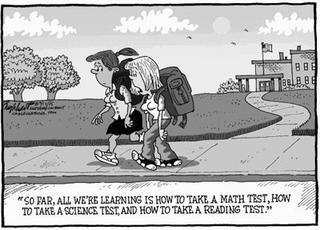
Why can’t we just go back to the amazing, off-the-wall concept of LEARNING ? That’s right, a child comes to school, behaves properly, and is exposed to all kinds of awesome concepts and facts and projects and and miracles and outer space and underground and inside a book and imagination and experiments and research and how to care for himself/herself and others so that when the student becomes an adult, he/she will be able to support and care for himself/herself and others, and use any leisure time to cultivate himself/herself culturally and to volunteer to help others?? And the big standardized test at the end of each year would simply cover those things that every person of ‘that age’ or ‘that level’ simply MUST KNOW in order to be a contributing member of society. No pass, no promote.
And music. Oh, the music the schools used to expose us to, and art. I still remember the smell of that pile of clay we all kept in our desks.
I learned dozens of major classical music pieces, in lower elementary school. They were disguised as simple, catchy songs.
But there is no time for the arts any more, or even recess in many schools. Every minute must be devoted to preparing for those tests, and that is wrong.
We are doing our students no favors by passing them along because of their age or their size or their parents’ standing in the community. We are doing them no favors by tailoring their curriculum to a test that doesn’t measure their ability to comprehend that they are in school to learn the things that will help them be the kind of adults that contribute to the world, not take from it.
I believe in testing. I just don’t believe a test is the purpose of education.
In real life, ‘test’ isn’t the final blow. In real life, “this is only a test” means that we shouldn’t worry. We give a test so people will be able to understand and use the concepts in real life. It’s what happens AFTER the test that is important. Those students who pass the test, are ready to move on to the next level, where they might use those skills and apply them to new things. Those who do not yet have the skills, should stay where they are until they have them. What good is it to move them ahead when they do not yet have the skills, ie tools, to comprehend the next level?
Some people are still playing junior varsity their senior year. So what? They weren’t ready to move up. Do people make a big deal out of that? (besides irate parents who know their kid is a superstar in disguise, that is.)
Don’t move ’em up till they demonstrate that they are ready to move up. That takes work. Some kids don’t know how to work. Keep them back until they learn. We’ve already got enough adults who don’t know how to work; we don’t need any more.
ISTEP is only a test. It’s a piece of paper.
Education isn’t about a standardized test. The test just measures how seriously a student takes that education. It measures who paid attention. It measures who CARES.
Those things are important. The test isn’t the goal. The test is only a test. Don’t panic; it’s only a test. If it had been a real situation, you would be at work, facing a problem that only a person who got number seventeen right on the test would know how to fix.
Sit up straight. Pay attention. If your kid’s teacher calls you, tell her to throw the book at your kid, and do it again when he comes home. Don’t allow any misbehavior at school. I do not advocate corporal punishment, but Annie Sullivan had to put her hands on Helen Keller to get her to calm down and behave; if that is what it takes for your kid, then do it. Some people require a little physical pressure; some don’t. Annie Sullivan knew that Helen had it in her to be awesome; the awesomeness just had to be mined. Today, Annie would be in the Rubber Room and Helen would have had a curriculum so tailor-made for her limitations that she would never have been able to go to college, let alone graduate Cum Laude from Radcliffe, go on the vaudeville circuit, write several books, lecture, and be received in the White House by twelve different presidents. In fact, she’d probably still be running wild and stealing food out of everybody’s plate, with her hands.
Students are SUPPOSED to be challenged in school. They’re supposed to have to work hard, and some will always have to work harder than others. Some kids have their homework done before they get off the bus, while others need four hours to get the same assignment half done. Not fair? Of course it’s not fair. It was never supposed to be fair; it’s supposed to challenge students and teach them to work so they won’t be societal leeches when they grow up.
Above all, we must not continue to shy away from our responsibilities as parents. We must not send our kids to school, or anywhere else in public, and not require excellent behavior. We must back up our teachers in the area of discipline; if that means you have to drive thirty-six miles after work to pick up your teen because he got ‘afterschool’ for talking back, then so be it. If you are angry at the school because of that, you’ve got a big, big problem, daddy or mommy, and with that attitude, it’s only going to get worse. If your kid misbehaves and is bagged for it, be angry with your kid, not the school. The school has a couple of thousand kids to deal with; if yours doesn’t choose to live with the good manners I’m sure you tried to teach him, that’s his problem. And yours. And if your kid got mouthy or violent or whatever, I’m GLAD he got bagged.
Do you know the main reason they used to hang horse thieves back in the day? That more horses might not be stolen. Get it?
Educated people are as much superior to uneducated people, as the living are to the dead. —Aristotle.
I know I say that all the time, but it’s absolutely true.
Civilization and sentience. I’m all for ’em. Without both, we are lost.