Poetry Friday: Langston Hughes
 Mamacita says: I first heard this poem in high school literature. Tenth grade, sophomore year, in Mrs. Helen Chandler’s class, she who taught Claude Akins, the Bedford Celebrity..
In retrospect, I know that we treated her dreadfully. She was quite elderly by the time my class came along, and had taught pretty much everybody in town. In her day, she was sharp, witty, and an excellent, highly respected teacher. In my day, she was partially blind, hard of hearing, and tired. I don’t think she comprehended half of what was done to her that year, and that is a good thing. A very good thing indeed.
The problem with retrospect is that more often than not, we see that instead of being the cool young rebels we thought we were, we see the truth: in this case, we were a classroom full of smartasses. Smartasses with a mean streak. I was an observer, not an instigator, but I laughed all the same.
Every snowflake in an avalanche pleads not guilty. — Stanislaw J. Lec 
I still remember all the wonderful poems she made us memorize, though. And now, I’m so glad she did that. I know some people don’t believe memorization is necessary any more, but they are wrong. WRONG.
Christmas isn’t necessary either, but isn’t it a delight, and aren’t we glad we have it? I rest my case.
In my head, I’ve got thousands of poems, stories, and even whole novels. I can close my eyes and read off my mind. Who needs books or electronics when you’ve had Mrs. Chandler?
I still remember the dancing, flying, screaming meltdown she gifted us with when she finally noticed the Playboy centerfold taped to her calendar, though. . . .
===
Dreams
Hold fast to dreams
For if dreams die
Life is a broken-winged bird
That cannot fly.
Hold fast to dreams
For when dreams go
Life is a barren field
Frozen with snow.
~Langston Hughes
And, yes. The poet speaks truth.
Quotation Saturday: A to B
 Mamacita says: I know, I know; it’s not Saturday. Saturday slid past me like a wet peeled potato, so I’m doing Quotation Saturday on Sunday. I’ve had far worse lapses. . . .
1. No two persons ever read the same book. — Edmund Wilson
2. An athlete was always a man that was not strong enough for work. Fractions drove him from school, and the vagrancy laws drove him to baseball. — Finley Peter Dunn
3. No great artist ever sees things as they really are. If he did, he would cease to be an artist. — Oscar Wilde
4. The applause of a single human being is of great consequence. — Samuel Johnson
5. If you don’t want anyone to know, don’t do it. — Chinese Proverb
6. America: where you have freedom of choice, but not freedom from choice. — Wendell Jones
7. The skillful artist will not alter his measures for the sake of a stupid workman. — Mencuis
8. Architecture is the flowering of geometry. — Emerson
9. The two most difficult careers are entrusted to amateurs – citizenship and parenthood. — St. John
10. We must not stint our necessary actions in the fear to cope malicious censurers. — Shakespeare
11. To be an artist is a great thing, but to be an artist and not know it is the most glorious plight in the world. — J.M. Barrie
12. An ape will be an ape, though clad in purple. — Erasmus
13. To be angry is to revenge the faults of others on ourselves. — Alexander Pope
14. The actions of men are the best interpreters of their thoughts. – Locke
15. The higher the ape goes, the more he shows his tail. — George Herbert
16. Being American is not a matter of birth. We must practice it every day, lest we become something else. — Malcolm Wallop
17. She is descended from a long line her mother fell for. — Gypsy Rose Lee
18. Art hath an enemy called ignorance. — Ben Jonson
19. Anyone who has the power to make you believe absurdities has the power to make you commit injustices. — Voltaire
20. A man that has a taste of musick, painting, or architecture, is like one that has another sense, when compared with such as have no relish of those arts. — Joseph Addison
21. He that seeks popularity in art closes the door on his own genius, as he must needs paint for other minds, and not for his own. — Anna Jameson
22. Astronomy compels the soul to look upwards and leads us from this world to another. — Plato
23. Behavior is a mirror in which every one shows his image. — Goethe
24. A bore is a man who deprives you of solitude without providing you with company. — Gravinia
25. A room without books is as a body without a soul. — Cicero
26. Be bold in what you stand for and careful what you fall for. — Ruth Boorstin
27. You don’t have to burn books to destroy a culture. Just get people to stop reading them. — Ray Bradbury
28. A sure sign of bureaucracy is when the first person who answers the phone can’t help you. — Dr. Kenneth J. Fabian
29. The organization of any bureaucracy is very much like a septic tank; the really big chunks always rise to the top. — Unknown (reminds me of a certain school system. . . .
30. All blessings are mixed blessings. — John Updike
31. Some things have to be believed to be seen. — Ralph Hodgson
32. Babies do not want to hear about babies; they like to be told of giants and castles, and of something which can stretch and stimulate their little minds. — Samuel Johnson
33. There is no past as long as books shall live. — Bulwer-Lytton
34. If you don’t get what you want, it is a sign either that you did not seriously want it, or that you tried to bargain over the price. — Rudyard Kipling
35. The man who does not read good books has no advantage over the man who can’t read ’em. — Mark Twain
36. If you never budge, don’t expect a push. — Malcolm Forbes
37. From one that reads but one book, the Lord deliver us. — Howell
38. You may have to fight a battle more than once to win it. — Margaret Thatcher
39. The one invincible thing is a good book; neither malice nor stupidity can crush it. — George Moore
40. We are slow to believe what if believed would hurt our feelings. — Ovid
41. If you see a bandwagon, it’s too late. — James Goldsmith
42. Nothing is so firmly believed as what we least know. — Montaigne
43. Bureaucracy is nothing more than the hardening of an organization’s arteries. — William P. Anthony
44. The man who first invented the art of supporting beggars made many wretched. — Menander
45. There is a great deal of difference between the eager man who wants to read a book, and the tired man who wants a book to read. — G.K. Chesterton
46. Some men has jist naturally got to have something to cuss around and boss, so’s to keep himself from finding out he don’t amount to nothing. — Don Marquis
47. The brighter you are, the more you have to learn. — Don Herold
48. There are books which take rank in our lives with parents and lovers and passionate experiences. — Emerson
49. A belief is not true because it is useful. — Amiel
50. How many a man has dated a new era in his life from the reading of a book…. — Thoreau
51. Let any man speak long enough, he will get believers. — R.L. Stevenson
52. The people who make no roads are ruled out from intelligent participation in the world’s brotherhood. — Margaret Fairless Barber
53. Good as it is to inherit a library, it is better to collect one. — Augustine Birrell
54. It is good to rub and polish our brain against that of others. — Montaigne
55. It is a tie between men to have read the same book. — Emerson
56. Some men will believe nothing but what they can comprehend, and there are but few things that such are able to comprehend. — Euremond
57. Some people manage by the book, even though they don’t know who wrote the book or even what book. — Unknown
58. Sits he on never so high a throne, a man still sits on his bottom. – Montaigne
59. By bearing old wrongs you provoke new ones. — Publilius Syrus
60. We work to become, not to acquire. — Elbert Hubbard
Poetry Friday: Haunted Houses
Mamacita says: I first encountered this poem when I was in the third grade in my favorite teen girl detective series – Judy Bolton, of course! (Nancy Drew is but a pale substitute. . . .) After the Bolton family moves into the neighborhood’s resident haunted house, Judy’s brother Horace recites this poem, frightening some of Judy’s more timid friends but NOT, of course, Judy herself. It’s a beautiful poem, because some hauntings, you know, are themselves beautiful: not scary at all.
I also love this poem because of its richness of vocabulary. I love a piece of writing that makes me look up a word; it’s like a challenge.
Haunted Houses
All houses wherein men have lived and died
Are haunted houses. Through the open doors
The harmless phantoms on their errands glide,
With feet that make no sound upon the floors.
We meet them at the door-way, on the stair,
Along the passages they come and go,
Impalpable impressions on the air,
A sense of something moving to and fro.
There are more guests at table than the hosts
Invited; the illuminated hall
Is thronged with quiet, inoffensive ghosts,
As silent as the pictures on the wall.
The stranger at my fireside cannot see
The forms I see, nor hear the sounds I hear;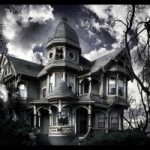
He but perceives what is; while unto me
All that has been is visible and clear.
We have no title-deeds to house or lands;
Owners and occupants of earlier dates
From graves forgotten stretch their dusty hands,
And hold in mortmain still their old estates.
The spirit-world around this world of sense
Floats like an atmosphere, and everywhere
Wafts through these earthly mists and vapours dense
A vital breath of more ethereal air.
Our little lives are kept in equipoise
By opposite attractions and desires;
The struggle of the instinct that enjoys,
And the more noble instinct that aspires.
These perturbations, this perpetual jar
Of earthly wants and aspirations high,
Come from the influence of an unseen star
An undiscovered planet in our sky.
And as the moon from some dark gate of cloud
Throws o’er the sea a floating bridge of light,
Across whose trembling planks our fancies crowd
Into the realm of mystery and night,—
So from the world of spirits there descends
A bridge of light, connecting it with this,
O’er whose unsteady floor, that sways and bends,
Wander our thoughts above the dark abyss.